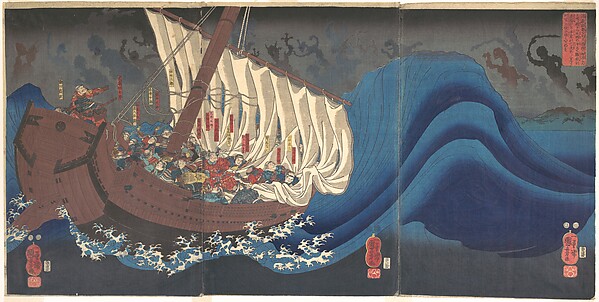
Kamakura: government by the winners
Minamoto no Yoritomo did something no previous victor had done. Rather than move to Kyoto and absorb the court's habits, he kept his headquarters at Kamakura, a defensible coastal town three hundred miles east, and governed from there through his own institutions. The emperor kept the throne, the ceremonies and the calendar. Yoritomo took the appointments, the land and the soldiers. In 1192 he was named sei-i taishogun. The dual structure this created — a sacred sovereign and a military ruler — lasted, with interruptions, for the next 676 years.
The irony is that his own line lasted barely thirty. Both his sons were murdered, and power passed to his widow's family, the Hojo, who ruled as regents to shoguns who were themselves figureheads for an emperor who was also a figurehead. Japanese political history has a persistent taste for the man behind the man behind the man.
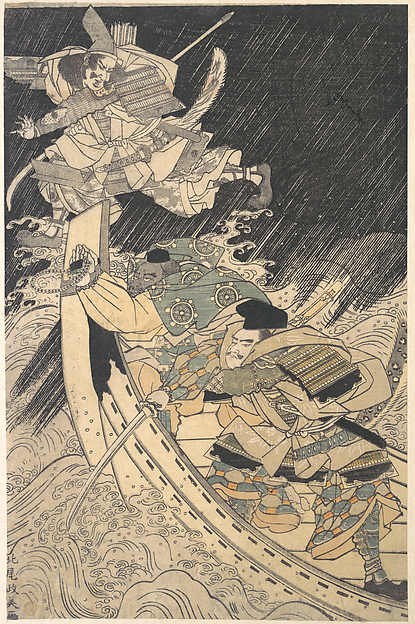
The Mongols, twice
In 1274 and again in 1281, Kublai Khan sent invasion fleets against Kyushu. The second was enormous — contemporary accounts claim well over four thousand ships and something like 140,000 men, drawn from Mongol, Chinese and Korean forces. The Japanese defence was competent, and the stone wall built along Hakata Bay between the two attempts did real work. But both campaigns ended with typhoons wrecking the fleets at anchor.
The storms were named kamikaze, divine winds, and the idea that the islands were under supernatural protection entered the national vocabulary permanently — and was deliberately revived, with catastrophic results, in 1944.
Victory nearly broke the shogunate. A defensive war produces no conquered land, and the Hojo had nothing with which to reward the warriors who had ruined themselves answering the call. Resentment accumulated for fifty years, and in 1333 Emperor Go-Daigo found enough of it to destroy the Kamakura regime.
Ashikaga Japan: weak government, extraordinary culture
Go-Daigo's attempt to restore direct imperial rule lasted three years before Ashikaga Takauji turned on him, installed a rival emperor, and took the shogunate for himself. Go-Daigo fled south with the regalia, and for fifty-six years Japan had two rival imperial courts — the Nanboku-cho, or Northern and Southern Courts — before the schism was patched up in 1392.
The Ashikaga governed from the Muromachi district of Kyoto and were, as a rule, weak. What they were exceptionally good at was patronage. Almost everything the world now recognises as classical Japanese aesthetics was formalised in this period:
- No theatre
- Codified by Zeami (c. 1363–1443) under the patronage of the shogun Yoshimitsu. Masked, slow, musically austere, and built around the idea of yugen — a profound, half-glimpsed beauty. Still performed; still demanding.
- The tea ceremony
- Developed from Zen monastic practice into chanoyu, and pushed by Sen no Rikyu (1522–91) toward wabi: small rooms, rough native ware, a deliberate rejection of Chinese display. Rikyu served Hideyoshi and was ordered to kill himself in 1591, for reasons still argued over.
- The dry garden
- Karesansui — raked gravel and placed stone, no water. Ryoan-ji in Kyoto, fifteen rocks in white gravel, is the famous one, and no two accounts of what it means agree.
- Ink painting, ikebana, linked verse
- Monochrome landscape painting reaches its Japanese peak with Sesshu; flower arrangement and renga both become disciplined arts with schools and lineages.
The two Kyoto pavilions bracket the period and its temperament. Kinkaku-ji, the Golden Pavilion, was Yoshimitsu's retirement villa, finished around 1397 and gold-leafed on two of its three floors — confident, show-off, continental. Ginkaku-ji, the Silver Pavilion, was built by his grandson Yoshimasa in the 1480s and never silvered at all. Yoshimasa spent the Onin War designing gardens while his capital burned.
The Kinkaku-ji you photograph is a 1955 reconstruction. A novice monk burned the original down in 1950 — the event Yukio Mishima turned into The Temple of the Golden Pavilion. This is a recurring feature of Japanese heritage: continuity of form matters more than continuity of material.
Sengoku: the country at war with itself
The Onin War (1467–77) began as a succession dispute inside the Ashikaga house and turned into a decade of street fighting that destroyed most of Kyoto. When it ended, nobody had won and the shogunate's authority outside the capital had evaporated. What followed is the Sengoku jidai, the age of the country at war: roughly 130 years in which perhaps 250 regional warlords — daimyo — fought over territory that no central power could adjudicate.
It was also an age of gekokujo, “the low overturning the high”. Retainers displaced their lords routinely. Merit and violence counted for more than pedigree, which is why the three men who ended the period came from nowhere in particular.
Guns, and the Europeans who brought them
Portuguese traders were shipwrecked on Tanegashima in 1543 carrying matchlock arquebuses. Japanese smiths reverse-engineered them within a year and were producing them in quantity within a decade — by some estimates Japan had more firearms than any European state by the 1570s. Francis Xavier landed at Kagoshima in 1549, and by the 1580s there were perhaps 150,000 Japanese Christians, concentrated in Kyushu.
Oda Nobunaga used both. At Nagashino in 1575 his massed gunners, firing from behind palisades, destroyed the Takeda cavalry — the set piece of every film about the period. He was ruthless with institutional rivals, burning the monastery complex on Mount Hiei in 1571 and killing thousands. He had unified perhaps a third of the country when a subordinate, Akechi Mitsuhide, turned on him at the Honno-ji temple in Kyoto in 1582 and forced his suicide.
Toyotomi Hideyoshi, a peasant-born general, avenged him within a fortnight and finished the unification by 1590. His domestic settlement was shrewd: a nationwide land survey, and the katanagari — the sword hunt of 1588 — which disarmed the peasantry and fixed the boundary between warrior and farmer that the Tokugawa would later freeze into law. His foreign policy was a disaster: two invasions of Korea, in 1592 and 1597, which achieved nothing, killed enormous numbers of Koreans, and collapsed on his death in 1598.
Tokugawa Ieyasu was the patient one. He had been a hostage as a child, an ally to Nobunaga, and a nominal subordinate to Hideyoshi. When Hideyoshi died leaving a five-year-old heir and a council of regents, Ieyasu spent two years assembling a coalition and then won the decisive battle at Sekigahara in October 1600 — partly through defections arranged in advance. He was named shogun in 1603, and finished the Toyotomi at Osaka Castle in 1615.
Nobunaga pounded the rice, Hideyoshi kneaded the dough, and Ieyasu sat down and ate the cake. A traditional Japanese saying
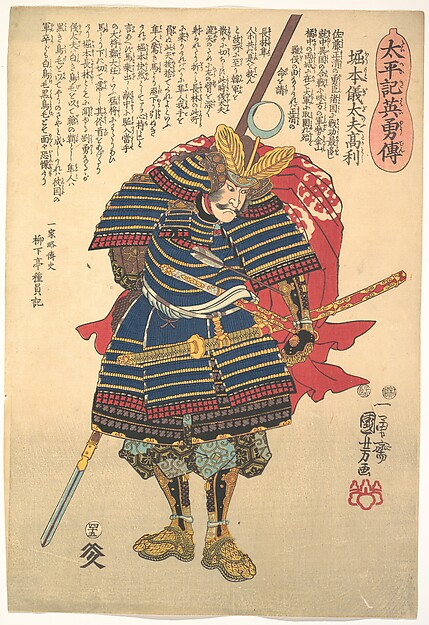
The samurai, minus the varnish
It is worth separating the warrior of the Sengoku from the figure the Edo period invented afterwards. Bushido as a written code is largely a product of the long peace — Yamaga Soko in the seventeenth century, the Hagakure around 1716, and then a heavy Meiji and pre-war reworking for nationalist purposes. Nitobe Inazo's Bushido: The Soul of Japan (1900), which shaped the Western image almost single-handedly, was written in English for a foreign readership by a Quaker-influenced Christian.
Actual warring-states samurai changed sides for advantage, fought mostly with bow and spear rather than the sword, and were outnumbered on the battlefield by ashigaru foot soldiers. The loyalty-unto-death ideal is real as an ideal. It was not a reliable description of behaviour.
Visiting this period today
- Kamakura. An hour from Tokyo. The Great Buddha at Kotoku-in has sat in the open since a tsunami took its hall in 1498; Engaku-ji and Kencho-ji are the serious Zen foundations.
- Kyoto's Zen temples. Ryoan-ji for the dry garden, Daitoku-ji's sub-temples for tea architecture, Tofuku-ji for the finest autumn colour in the city and a modernist garden by Shigemori Mirei.
- Himeji Castle. The best surviving castle in Japan by a long distance, and one of only twelve original keeps. White, enormous, and structured entirely around killing people who get inside the walls.
- Matsumoto for a black original keep against the Alps; Hikone and Inuyama for two more.
- Sekigahara. A small town with a genuinely good battlefield memorial museum opened in 2020; you can walk the actual troop positions in an afternoon.
- Mount Koya and Mount Hiei for the monastic power that Nobunaga found intolerable — and, at Koya, a cemetery holding the graves of most of the warlords named on this page.