About this site
What wrote it, how much you should trust it, how it is built, and where the pictures came from.
Nobody wrote this
Every chapter, guide, caption and image description on this site was generated by Claude, a large language model made by Anthropic. It was produced in a handful of sittings at a keyboard belonging to someone who was not writing it, and published by scripts in the same repository. No historian was consulted. No editor read it. Nothing on this site has been checked against a source.
That is worth stating plainly, because the prose is designed to sound like a person who knows the subject — unhurried, specific, willing to say when something is disputed. It reads like authority and it is not. A language model produces the shape of a well-informed sentence whether or not the fact inside it is right, and it is at its most convincing exactly where it is wrong: a date shifted by a decade, a temple attributed to the wrong shogun, a rail pass that stopped existing last year. Nothing here flags itself when it does that.
The site is named for and made for Jack Cowley, which is where the domain comes from. He did not write it either — it was made as a gift. An earlier version of this page credited him as the author, which was a nice gesture and completely untrue, so it has been corrected.
How it is built
Deliberately plainly. It is a static site: plain HTML and one stylesheet, assembled from content fragments by a small PowerShell build script. There is no framework, no bundler, no analytics, no cookies, no third-party requests and no JavaScript required to read anything. The images are served from this domain rather than hotlinked from anyone else's.
The reason for the build step is the archive. When a guide is added, every existing page has to learn about it — navigation, footer, sitemap. One template regenerated from one manifest makes that reliable instead of tedious.
How the archive grows
The guides are short pieces on single subjects — a station, a dish, a shrine, a walk. Each one is written into the same template as everything else, added to the footer and listed in the sitemap.
Nothing publishes unless somebody asks for it. Jack signs in with the account button at the top right of any page and types what the next piece should be about; a scheduled job picks that up and publishes it. With an empty queue the job runs, finds nothing requested, writes a line in its log and stops. It used to help itself to the next entry on a standing list of topics every half hour, which meant the archive grew whether or not anyone wanted it to. It no longer does that.
Do not rely on this site for anything that matters. The history is a language model's recollection of the standard account rather than a reading of it, and the travel material is worse: fares, entry fees, opening hours and rules change, often at the start of the Japanese fiscal year in April, and a model trained months or years ago will state the old rule with complete confidence. Every page is a starting point for your own checking — confirm anything you are going to act on with the operator, the museum, or the relevant official tourism body.
Artwork credits
The pictures are the one part of this site that is genuinely old and genuinely verified. Every image is a Japanese woodblock print in the public domain, released under Creative Commons Zero (CC0) through The Metropolitan Museum of Art's Open Access programme. The files were downloaded once and are served from this domain; the museum is credited here and in the caption beside each print.
The artist, title and date in the table below come from the museum's own catalogue record and were fetched from its API, not recalled by a model. Anything else said about a print — the descriptions, the alt text, the connections drawn between an image and the page it sits on — is AI-written like the rest of the site, and carries the same warning.
This list is generated from the same manifest the download script writes, so it cannot drift out of step with what is actually on the site.
| Work | Artist | Date | Credit line |
|---|---|---|---|
| Under the Wave off Kanagawa (Kanagawa oki nami ura), also known as The Great Wave, from the series Thirty-six Views of Mount Fuji (Fugaku sanjūrokkei) ↗ | Katsushika Hokusai | ca. 1830–32 | H. O. Havemeyer Collection, Bequest of Mrs. H. O. Havemeyer, 1929 |
| South Wind, Clear Sky (Gaifū kaisei), also known as Red Fuji, from the series Thirty-six Views of Mount Fuji (Fugaku sanjūrokkei) ↗ | Katsushika Hokusai | ca. 1830–32 | Henry L. Phillips Collection, Bequest of Henry L. Phillips, 1939 |
| Storm below Mount Fuji (Sanka no haku u), from the series Thirty-six Views of Mount Fuji (Fugaku sanjūrokkei) ↗ | Katsushika Hokusai | ca. 1830–32 | Rogers Fund, 1914 |
| Onna San no Miya (the Third Princess) ↗ | Suzuki Harunobu | 1768–70 | H. O. Havemeyer Collection, Bequest of Mrs. H. O. Havemeyer, 1929 |
| Matching Shells (Kai-awase), “Kisen Hōshi,” from the series Modern Parodies of the Six Poetic Immortals (Yatsushi rokkasen: Kisen Hōshi) ↗ | Chōbunsai Eishi | ca. 1796–98 | H. O. Havemeyer Collection, Bequest of Mrs. H. O. Havemeyer, 1929 |
| Minamoto Yoshitsune and His Retainer, the Monk Benkei, Putting to Flight the Ghost of Taira no Tomomori ↗ | Kuwagata Keisai | late 18th century | Gift of Estate of Samuel Isham, 1914 |
| Ghosts of the Taira at Daimotsu Bay ↗ | Utagawa Kuniyoshi | 1843–47 | Fletcher Fund, 1929 |
| Horimoto Gidayū Takatoshi ↗ | Utagawa Kuniyoshi | ca. 1848 | Purchase, Arnold Weinstein Gift, 2001 |
| Portrait of Oboshi Yuranosuke Yoshio (The Leader) ↗ | Utagawa Kuniyoshi | 1852 | Fletcher Fund, 1929 |
| “The Waterfall Where Yoshitsune Washed His Horse at Yoshino in Yamato Province,” from the series A Tour of Waterfalls in Various Provinces ↗ | Katsushika Hokusai | ca. 1832 | Henry L. Phillips Collection, Bequest of Henry L. Phillips, 1939 |
| Stations One: Morning View of Nihonbashi ↗ | Utagawa Hiroshige | ca. 1833–34 | Rogers Fund, 1918 |
| Sunshower at Nihonbashi ↗ | Utagawa Hiroshige | 1833–34 | Rogers Fund, 1918 |
| Two Women ↗ | Kitagawa Utamaro | ca. 1790 | The Howard Mansfield Collection, Purchase, Rogers Fund, 1936 |
| Set of Utensils for the Tea Ceremony ↗ | Kubo Shunman 窪俊満 | 1810s | H. O. Havemeyer Collection, Bequest of Mrs. H. O. Havemeyer, 1929 |
| Street in Kyoto ↗ | Utagawa Hiroshige | ca. 1840 | Gift of Estate of Samuel Isham, 1914 |
| Kiyomizu Temple (Kiyomizu), from the series Famous Views of Kyoto (Kyōto meisho no uchi) ↗ | Utagawa Hiroshige | ca. 1834 | Rogers Fund, 1922 |
| The Kinryusan Temple at Asakusa ↗ | Utagawa Hiroshige | 1856 | Gift of Estate of Samuel Isham, 1914 |
| Ōtsu, from the series The Fifty-Three Stations of the Tōkaidō Road (Tōkaidō gojūsan tsugi, Ōtsu) ↗ | Utagawa Hiroshige | 1841–44 | Purchase, Joseph Pulitzer Bequest, 1918 |
| Night Rain at Karasaki, from the series Eight Views of Ōmi (Ōmi hakkei no uchi) ↗ | Utagawa Hiroshige | ca. 1835 | Rogers Fund, 1914 |
| Evening Cherry Blossoms at Gotenyama ↗ | Utagawa Hiroshige | 1831 | The Howard Mansfield Collection, Purchase, Rogers Fund, 1936 |
| Cherry Blossoms at Arashiyama, from the series Famous Places of Kyōto ↗ | Utagawa Hiroshige | ca. 1834 | Rogers Fund, 1914 |
| Maples at Mama, from the series One Hundred Famous Views of Edo ↗ | Utagawa Hiroshige | ca. 1857 | Purchase, Joseph Pulitzer Bequest, 1918 |
| Evening Snow ↗ | Utagawa Hiroshige | 1797–1861 | Henry L. Phillips Collection, Bequest of Henry L. Phillips, 1939 |
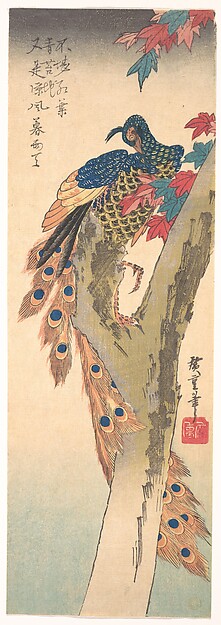
| A Peacock Perched on a Maple Tree ↗ | Utagawa Hiroshige | ca. 1833 | Purchase, Joseph Pulitzer Bequest, 1918 |
| Wild Geese Flying under the Full Moon ↗ | Utagawa Hiroshige | ca. 1833 | Purchase, Joseph Pulitzer Bequest, 1918 |
| Fuji from Miura, Sagami (Soshu Miura no Kaijo), from the series Thirty-six Views of Mount Fuji (Fugaku sanjūrokkei) ↗ | Utagawa Hiroshige | 1858 | Rogers Fund, 1919 |
Corrections
There is no editor watching this site, so nothing corrects itself and no one is checking behind the model. If a page here contradicts a museum, an operator, a rail company or a historian, believe them. An image whose public-domain status turns out to be wrongly recorded upstream would be removed — that one is worth flagging to whoever runs the domain.