Shinto and Buddhism: not a competition
The most common question visitors arrive with is which religion Japan follows, and the honest answer is that the question does not map. Surveys routinely find that most Japanese people describe themselves as non-religious while also visiting a shrine at New Year, holding a Shinto wedding and a Buddhist funeral. That is not hypocrisy; it reflects a division of labour that is centuries old.
Shinto · 神道
The way of the kami
Indigenous, with no founder, no scripture and no doctrine of an afterlife. It is concerned with kami — presences in mountains, trees, waterfalls, ancestors, exceptional people — and above all with purity: washing, salt, renewal. It handles beginnings. Births, weddings, new buildings, new years.
Buddhism · 仏教
Arrived 538, stayed
Came via Korea and China, bringing writing and philosophy with it. It handles endings — funerals and memorial rites are overwhelmingly Buddhist — and supplies the metaphysics that Shinto has no interest in providing.
For over a thousand years the two were formally fused under shinbutsu shugo, with kami understood as local manifestations of buddhas and the two housed on the same grounds. The Meiji government forcibly separated them in 1868 to build a state-centred Shinto around the emperor, and a wave of anti-Buddhist destruction followed. State Shinto was dismantled by the occupation in 1945.
A shrine (jinja, name usually ending -jingu, -taisha or -gu) has a torii gate, guardian dogs or foxes, a water basin at the entrance, and often rope with folded paper streamers. A temple (tera, name usually ending -ji, -dera or -in) has a roofed gate with guardian figures, an incense burner, a graveyard, and Buddha images. Both welcome visitors. Neither expects you to believe anything.
What to do at a shrine, briefly
- Bow once at the torii. Walk to one side of the centre of the path — the middle is nominally for the kami.
- At the basin: rinse the left hand, the right hand, then pour into a cupped hand to rinse the mouth. Never drink from the ladle.
- At the hall: coin in the box, ring the bell if there is one, then two bows, two claps, a moment of silence, one bow.
At a temple there is no clapping. Bow, offer incense if it is set up for it, and put your hands together in silence.
An aesthetic vocabulary
- Mono no aware — 物の哀れ
- The pathos of things: a gentle sadness at transience, and the sense that impermanence is what makes something beautiful rather than what spoils it. The reason cherry blossom matters is precisely that it lasts about a week.
- Wabi-sabi — 侘寂
- Two words, often mangled in English. Wabi is austere, understated simplicity; sabi is the beauty that age and wear confer. Together: the rough tea bowl preferred over the flawless imported porcelain.
- Ma — 間
- Interval — the emptiness between things, treated as an active element rather than leftover space. It governs garden composition, No timing, and the layout of a room.
- Shibui — 渋い
- Restrained, unshowy good taste. Applied to a colour, a fabric, a person, a performance. Closer to “quietly excellent” than to “plain”.
- Kintsugi — 金継ぎ
- Repairing broken pottery with lacquer and gold so the break is highlighted, not hidden. A physical statement of the same argument about impermanence.
The tea ceremony
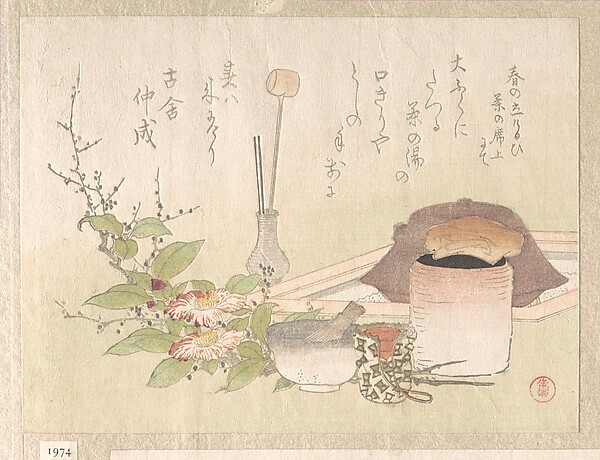
Chanoyu is not primarily about tea. It is a choreographed encounter in which every element — the scroll in the alcove, the flowers, the kettle, the sweet, the sequence of movements — is chosen for that gathering, on that day, for those guests. The governing phrase is ichi-go ichi-e: one time, one meeting. This gathering will not recur, so attend to it.
Sen no Rikyu shaped the form in the sixteenth century around deliberate poverty: a two-mat room, a low crawl-through entrance that obliged even a warlord to leave his sword outside and enter bent, and rough domestic ware in place of Chinese display pieces. Three schools descended from his grandsons still teach it.
As a visitor you will most likely meet the short form: a bowl of whisked matcha and a sweet, at a garden teahouse, for a small fee. Take the sweet first. Turn the bowl a couple of times so you do not drink from the front. Drink in three or so mouthfuls, finish audibly, turn the bowl back and set it down.
Food is regional, and that is the point
The single most useful thing to know about eating in Japan is that the national cuisine is a set of strong regional cuisines. Ordering the local speciality is not tourist theatre; it is how the country eats.
| Place | Eat | Why |
|---|---|---|
| Osaka | Okonomiyaki, takoyaki, kushikatsu | The self-declared “nation’s kitchen”; cheap, loud, fried, excellent |
| Kyoto | Kaiseki, yudofu, obanzai | Court and temple cooking — vegetarian-friendly, seasonal, restrained |
| Fukuoka | Hakata ramen | Thin noodles in rich pork-bone broth, ideally from a riverside yatai stall |
| Sapporo | Miso ramen, soup curry, seafood | Cold-climate cooking; Hokkaido dairy and crab are the best in the country |
| Hiroshima | Okonomiyaki (layered, with noodles), oysters | A genuinely different construction from the Osaka version, and locals will tell you so |
| Nagoya | Hitsumabushi, miso katsu, tebasaki | Red miso used with a heavy hand; grilled eel served three ways in one bowl |
| Kanazawa | Sushi, jibuni, gold leaf on everything | Sea of Japan winter fish is exceptional and the city knows it |
| Okinawa | Goya champuru, rafute, Okinawa soba | A separate kingdom until 1879, with a food culture to match |
Two things worth knowing at the table. Tipping is not done anywhere — it causes confusion and occasionally offence. And it is normal to eat well for very little: a teishoku set lunch, a bowl of ramen, or a department store basement depachika at closing time will all feed you properly for the price of a sandwich at home.
Vegetarian and vegan travel is manageable but takes planning: dashi, the fundamental stock, usually contains dried bonito, so even vegetable dishes are often not vegetarian. Shojin ryori — Buddhist temple cuisine, on Koya-san and at temples in Kyoto and Kamakura — is entirely plant-based and superb. Carry a written card explaining your requirements in Japanese.
Crafts, and where they survive
- Ceramics. Distinct traditions with their own clay and glaze: Bizen (unglazed, wood-fired), Hagi (pale, crazed, changes with use), Mashiko (the folk-craft centre), Arita and Imari (porcelain, Kyushu), Karatsu, Shigaraki.
- Textiles. Kyoto's Nishijin weaving, Kanazawa's Kaga yuzen dyeing, Okinawan bingata, and indigo aizome in Tokushima.
- Lacquer. Wajima on the Noto peninsula for the most exacting work — dozens of layers, each polished.
- Paper. Washi from Mino, Echizen and Ogawa, still made by hand from mulberry bast and used for everything from conservation to sliding doors.
- Knives. Sakai near Osaka and Seki in Gifu, both descended directly from sword-making towns.
The mingei movement of the 1920s and 30s, around Yanagi Soetsu, argued that anonymous everyday craft was the real Japanese art tradition. The Japan Folk Crafts Museum in Tokyo, which he founded, remains the best single place to test the argument.
The etiquette that actually matters
Most of what circulates online is overstated. Nobody expects a foreign visitor to get everything right, and effort is read generously. A short list of things that genuinely register:
- Shoes off where there is a step up and a rack — homes, temples, many restaurants, all ryokan, some clinics and fitting rooms. This one is not optional.
- Wash before you get in at an onsen or sento. The bath is for soaking in, not for cleaning in; everyone washes seated at the taps first, and the small towel does not go in the water.
- Quiet on trains. Phones on silent, no calls. It is the most consistently observed public norm in the country.
- Do not stick chopsticks upright in rice, and do not pass food chopstick to chopstick. Both echo funeral rites.
- Two hands for a business card, and read it before putting it away.
- Take rubbish with you. Public bins are scarce — a legacy of the 1995 subway attack. Locals carry it home.
- Ask before photographing people, and take the “no photography” signs in Gion and similar districts at face value. They exist because of real harassment of working geiko and maiko.
- Tattoos still bar entry to some onsen and pools. Many places have relaxed; many have not. Cover-up patches, private family baths (kashikiri) and tattoo-friendly listings all solve it.
Ichi-go ichi-e — one time, one meeting. The governing idea of the tea room, and a reasonable way to travel