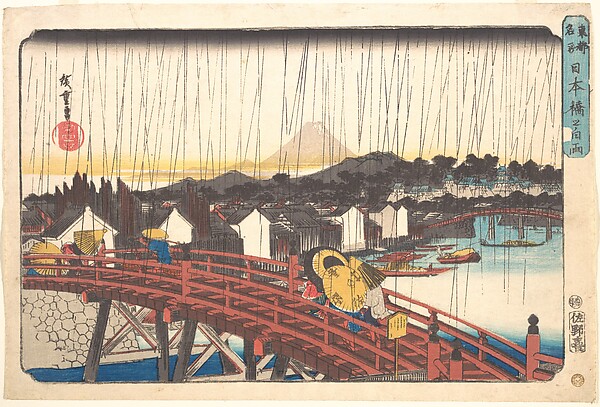
The Tokugawa settlement
Ieyasu's problem was not winning. It was making the win permanent, given that every previous unifier's arrangement had collapsed within a generation. The answer was a system designed to make rebellion structurally impossible, and it worked so well that the country did not fight a serious internal war for two and a half centuries.
- Alternate attendance (sankin kotai)
- Every daimyo had to spend alternate years in Edo, and leave his wife and heir there permanently as hostages. The processions between domain and capital were ruinously expensive — which was the point. A lord spending a third of his revenue on travel and a second household has nothing left to raise an army with. It also built the road network and the inn towns along it.
- Domain classification
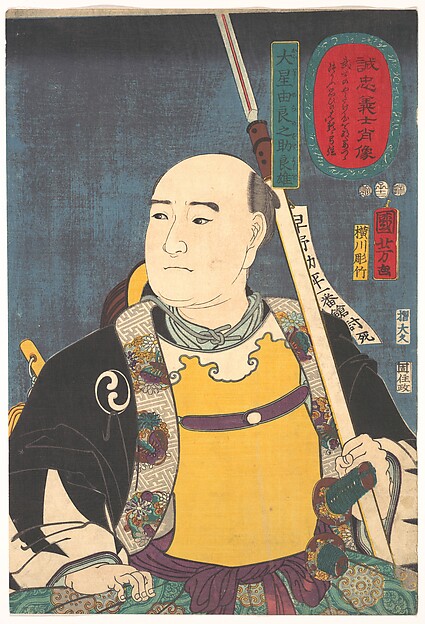
- The 250-odd domains were sorted into fudai (Tokugawa allies from before Sekigahara, given small strategic holdings near the capital and the actual government jobs) and tozama (outside lords, often rich, deliberately placed far away and excluded from office). Satsuma and Choshu were tozama. They waited 265 years and then destroyed the shogunate. The system was not perfect.
- Fixed status order
- Warrior, farmer, artisan, merchant — in theory hereditary and unchangeable, with outcast groups outside it entirely. In practice the order inverted: samurai on fixed rice stipends slid into debt, while the merchants they officially outranked accumulated the country's liquid wealth.
- Closure (sakoku)
- Christianity was banned, missionaries expelled and Japanese converts persecuted; after the Shimabara rebellion of 1637–38 the policy hardened. Japanese subjects were forbidden to leave, and returnees faced death.
Japan was not sealed. It was channelled. Four gateways stayed open under tight control: the Dutch at Dejima in Nagasaki, Chinese traders also at Nagasaki, Korea through Tsushima, and the Ryukyu kingdom through Satsuma. Dutch books kept flowing in, and a whole scholarly discipline — rangaku, “Dutch learning” — grew up around European anatomy, astronomy and gunnery. When Japan decided to modernise in the 1860s it was not starting from ignorance.
Edo: a million people, mostly on foot
The village Ieyasu made his headquarters in 1590 was, within a century, probably the largest city in the world — over a million people by the early 1700s, ahead of London and Paris. Roughly half were samurai and their dependants, quartered around the castle; the other half were the townspeople, chonin, packed into the low-lying eastern districts at densities that make modern Tokyo look spacious.
It burned constantly. The Meireki fire of 1657 destroyed most of the city and killed something on the order of a hundred thousand people. Firefighting brigades became civic institutions with their own iconography, and the city developed a fatalistic relationship with its own impermanence that shows up everywhere in its art.
It was also, by the standards of any contemporary European capital, astonishingly clean and well fed. Night soil was a traded commodity with a market price, collected systematically and sold to farmers — a closed nutrient loop that European cities did not manage until the late nineteenth century. Literacy was high: perhaps 40% of men and 15% of women, taught in thousands of small neighbourhood terakoya schools.
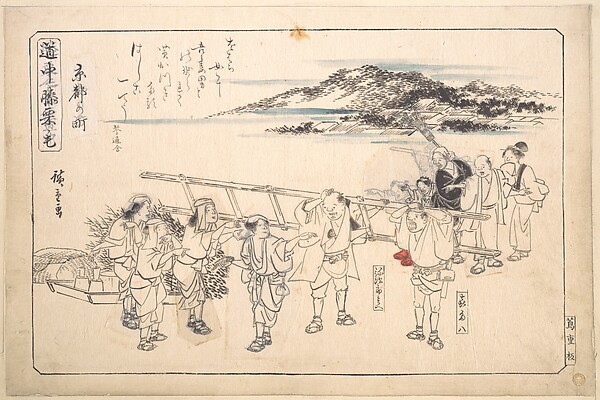
The floating world
Ukiyo was originally a Buddhist term for the sorrowful, transient world. Edo townspeople rewrote it with a different character — the floating world — and made it mean the pleasure districts: theatres, teahouses, the licensed quarter at Yoshiwara, and the actors and courtesans who were its celebrities.
Ukiyo-e means pictures of that world, and it was a commercial mass medium, not a fine art. A print was made by a team — publisher, designer, block cutter, printer — and sold cheaply, roughly the price of a bowl of noodles. The technology of full-colour printing from multiple registered blocks (nishiki-e, brocade pictures) arrived in the 1760s with Suzuki Harunobu and opened up everything that followed.
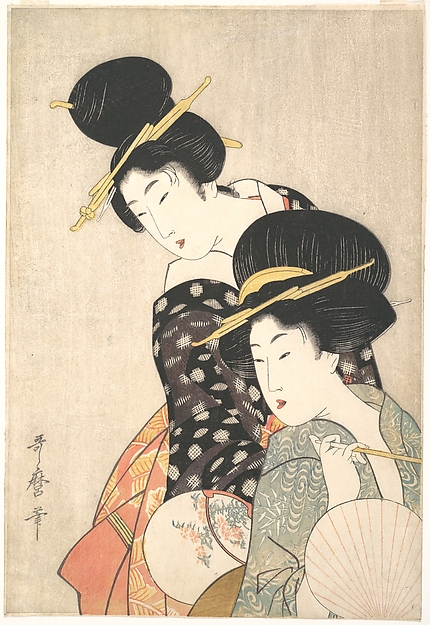
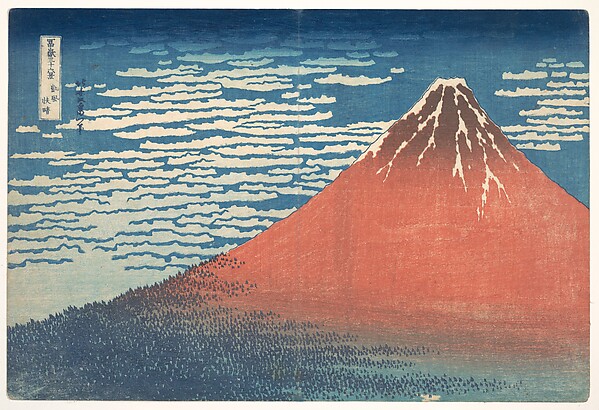
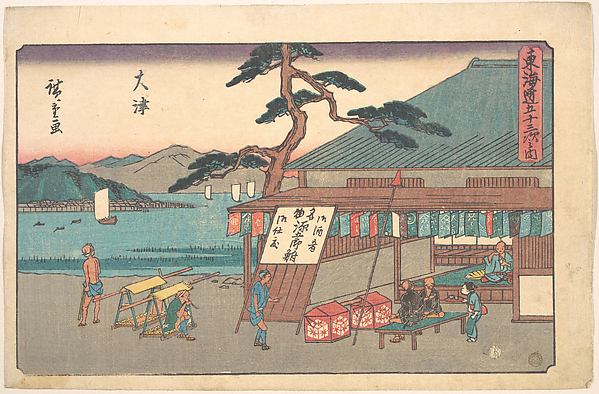
The two giants of the landscape print came late. Katsushika Hokusai published Thirty-six Views of Mount Fuji around 1830–32, when he was already past seventy; it contains Under the Wave off Kanagawa, now probably the most reproduced image in the history of art. Utagawa Hiroshige's Fifty-three Stations of the Tokaido followed in 1833–34 and sold on the back of a genuine domestic tourism boom — the same roads the daimyo processions used were now full of ordinary people going to see famous places.
Both series depend on a specific imported material: Prussian blue, a synthetic European pigment that reached Japan cheaply in the 1820s and was far more lightfast than the fugitive plant blues printers had used before. The distinctive deep blue of late ukiyo-e is a chemical accident of trade.
When Japan reopened, prints reached Europe as packing material and cheap curios, and the effect on French painting was immediate. Monet, Degas, Van Gogh, Whistler and Mary Cassatt all collected and copied them. Flat colour, asymmetric framing and the cropped, off-centre composition of Impressionism owe a direct and well-documented debt to Edo commercial printmaking.
Theatre and verse
Kabuki began around 1603 with a female troupe led by a woman named Okuni, was banned to women in 1629 on grounds of public morality, and became the all-male form it remains. It is loud, stylised, technically spectacular, and was regarded by the authorities as barely respectable — which is what made it popular. Bunraku puppet theatre developed alongside it, sharing playwrights; Chikamatsu Monzaemon wrote for both and is the period's major dramatist.
And Matsuo Basho (1644–94) took the opening verse of linked poetry and made it a form in its own right. Oku no Hosomichi — The Narrow Road to the Deep North — records a walking journey of some 2,400 kilometres through the northern provinces in 1689, and remains the most followed literary itinerary in Japan.
The summer grasses —
all that remains
of warriors’ dreams. Basho, at the ruined fortress of Hiraizumi, 1689
Why it ended
The system was already under strain before any foreign ship appeared. Samurai stipends were fixed in rice while the economy had monetised; the great merchant houses of Osaka were creditors to entire domains. Repeated famines — Tenmei in the 1780s, Tenpo in the 1830s — produced rural uprisings and urban rice riots. Reform programmes were attempted three times and each was largely abandoned.
On 8 July 1853, Commodore Matthew Perry brought four US warships into Edo Bay, two of them steam-powered, and refused to leave until a letter from the American president had been accepted. He returned in 1854 with nine ships, and the shogunate signed. The unequal treaties that followed — extraterritoriality, fixed tariffs Japan could not set — were a national humiliation and became the central grievance of the next forty years of foreign policy.
The shogunate's fatal error was consulting the daimyo about how to respond. Having admitted it could not decide alone, it never recovered the authority to decide at all. The slogan sonno joi — revere the emperor, expel the barbarians — became the banner for opposition from Satsuma and Choshu, the two great outside domains. Both were shelled by Western fleets in 1863–64, concluded from the experience that expulsion was impossible and modernisation essential, and allied against the shogunate in 1866.
The last shogun, Tokugawa Yoshinobu, resigned in November 1867. The Boshin War of 1868–69 mopped up the loyalists. In September 1868 Edo was renamed Tokyo — eastern capital — and the young emperor moved into the shogun's castle, where his descendants live still.
Visiting this period today
- The Nakasendo post towns. Tsumago and Magome in the Kiso valley preserve the Edo highway streetscape, and the eight-kilometre walk between them is the single best half-day in Japan for feeling what road travel was like.
- Edo-Tokyo Open Air Architectural Museum, Koganei — relocated period buildings you can walk into. In central Tokyo, the Fukagawa Edo Museum reconstructs a full 1840s neighbourhood indoors, complete with a lighting cycle from dawn to night.
- Kanazawa. Largely unbombed. The Nagamachi samurai district and the Higashi Chaya teahouse quarter are intact, and Kenroku-en is one of the three great daimyo gardens.
- Kabuki-za in Ginza sells single-act tickets on the day for a fraction of the full price — the right way to try it if you are unsure.
- Nagasaki. Dejima has been substantially reconstructed, and Oura Church and the Twenty-Six Martyrs memorial cover the Christian century and its suppression.
- Prints. The Ota Memorial Museum of Art in Harajuku rotates a small, excellent ukiyo-e collection. The Sumida Hokusai Museum sits in the neighbourhood where Hokusai actually lived.