Japan through time
A country that spent two centuries deliberately shut, then rebuilt itself twice inside a hundred years — and still keeps its eighth-century capital more or less where it left it. This is the history, and what you can do with it as a visitor.
There is a habit of describing Japan as a place where the ancient and the modern sit side by side. It is true enough to be useless. What is more interesting is how they sit together: which parts of the past were kept deliberately, which were destroyed and rebuilt as replicas, and which survived by accident because a particular valley was too awkward to bomb or too poor to modernise.
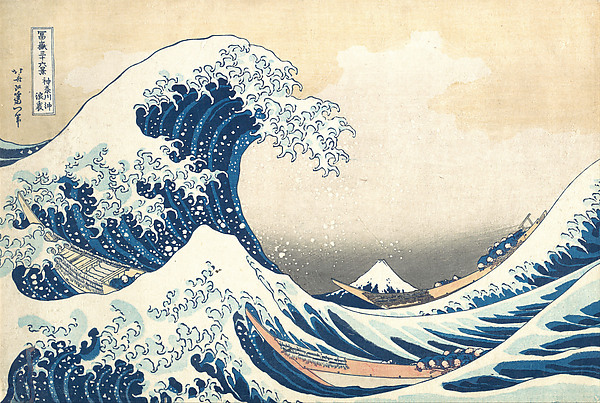
This site works through Japanese history in four long chapters — the classical court, the age of the warrior, the closed country of the Tokugawa, and the violent modernisation that followed — and then turns to the present: where to go, what is genuinely worth your time, and the practicalities that trip people up. Every illustration is a public-domain woodblock print, credited where it appears.
Islands in the archipelago. Four carry almost everyone.
Jomon pottery — among the oldest ceramic traditions anywhere.
Years Kyoto has been laid out on the same grid.
Of the country is forested mountain. It shapes everything.
A history in four movements
Each chapter stands on its own, but they are written to be read in order — the arguments carry forward.
14,000 BCE – 1185
Ancient & classical Japan
Hunter-gatherers with pottery, then rice, then a Chinese-style state grafted onto a clan society — and finally the Heian court, which invented a literature while barely governing anything.
Read the chapter1185 – 1603
The age of the samurai
Four centuries in which the warrior class took power, lost it, fought a civil war so long it became the country’s ordinary condition, and produced Zen, the tea ceremony and No theatre along the way.
Read the chapter1603 – 1868
The Edo period
Two hundred and fifty years of enforced peace and near-total closure, which produced the world’s largest city, a mass reading public, and the prints that illustrate this site.
Read the chapter1868 – today
Meiji to the present
A deliberate, state-driven demolition of the old order; empire; catastrophe; and then the fastest economic recovery in modern history, followed by three decades of learning to live without growth.
Read the chapter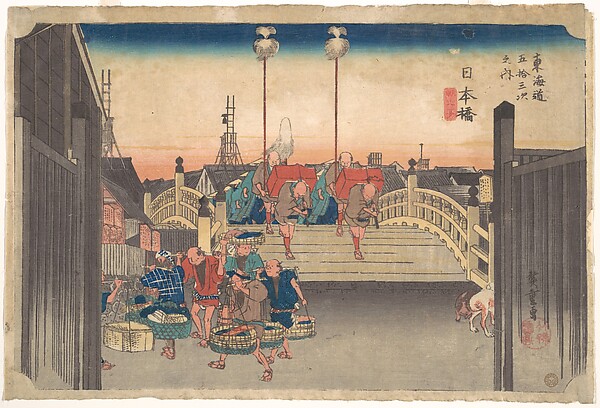
And what you can actually do there
History is the reason most of this is still standing. These pages are about using it — plus the onsen, the food, the mountains and the trains.
Experiences
Things worth doing
Temple lodging on Koya-san, the Nakasendo post road on foot, sumo from the cheap seats, a proper sento, and the art islands of the Inland Sea.
BrowseRegions
Where to go
Hokkaido to Okinawa — what each region is actually for, and why the Tokyo–Kyoto–Osaka corridor is both the obvious answer and the worst one.
BrowseSeasons
When to go
The blossom front, the rainy season, the brutal August humidity, the autumn colour, and the festivals that are worth building a trip around.
BrowseCulture
How to read it
Shinto and Buddhism sharing a site without contradiction; what happens in a tea room; why the food is regional; and the etiquette that actually matters.
BrowsePractical
Planning a trip
Rail passes and whether they still pay off, IC cards, money, connectivity, luggage forwarding, and the two or three things that genuinely catch people out.
BrowseArchive
The guides
Shorter pieces on single subjects — a station, a dish, a shrine, a walk. New ones appear when somebody asks for one.
BrowseThe whole thing in twelve dates
If you read nothing else, these are the hinges everything else turns on.
-
c. 14,000 BCE
The Jomon begin making pots
Sedentary hunter-gatherers on a rich coastline, with one of the earliest ceramic traditions on earth and no agriculture for ten thousand years.
-
c. 300 BCE
Wet rice arrives from the continent
The Yayoi bring paddy farming, bronze and iron. Population rises, surplus appears, and with it hierarchy and war.
-
538 / 552
Buddhism reaches the Yamato court
Arriving from the Korean kingdom of Baekje. Within a century it is state policy and the vehicle for Chinese writing, law and architecture.
-
710 & 794
Nara, then Heian-kyo
Two purpose-built capitals on a Chinese grid. The second becomes Kyoto and stays the imperial seat for over a thousand years.
-
1185
Minamoto no Yoritomo wins
Military government at Kamakura. The emperor reigns; the shogun rules. That split lasts, in one form or another, until 1868.
-
1274 & 1281
The Mongols come twice, and fail twice
Storms wreck both fleets. The word kamikaze — divine wind — enters the language, and is reached for again in 1944.
-
1467–1477
The Onin War burns Kyoto
Central authority collapses. A century and a half of warring states follows.
-
1600
Sekigahara
Tokugawa Ieyasu wins the decisive battle; shogun by 1603. The dynasty holds for fifteen generations.
-
1630s
The country closes
Christianity banned, foreign trade throttled to a Dutch enclave at Nagasaki and controlled channels to China, Korea and the Ryukyus.
-
1853
Perry’s squadron enters Edo Bay
Four American warships end the arrangement. The shogunate does not survive the decade and a half that follows.
-
1868
The Meiji Restoration
Rule returned to the emperor in name; in practice a small group of reformers dismantles the feudal order and builds an industrial state at speed.
-
1945
Defeat, occupation, and a new constitution
Everything after — the economic miracle, the bubble, the long slow decades, Reiwa — runs from that break.